Tuesday, November 16, 2010

Behind, behind, behind

I haven't worked on my nano for days.  Why?  You can read why on my Happy Freelancer blog post.  Winning nano this month isn't too likely, even if I get 50,000 words.  Why?  Because these words are out of order.  Even so, I am going to write everyday, but to boot, I am editing my Key Scene/Plot Points.  I only have the Ending left to write.  It will be interesting to edit the Beginning at the same time as I write the Ending, because the two will play off each other.

Anyway, I will not make nano this year, but I will write, at my own pace, and I will edit, at my own pace, too.  And as Sam Wyly wrote in 1,000 Dollars and Idea*, defeat simply means you have a new goal to set.  So, I will set a goal for this month.  To have the edited Key Scene/Points posted on this blog by November 30th.  And that goal and others will help me toward achieving my ultimate:  to have the entire novel posted on this blog** by December 31st.  

===================

Notes:

* Amazon Affiliate link. 

** That does not mean a complete novel, ready to be sold.  This is merely the first round of editing.  The novel will still have another editing session left.  Even then, I wait until the entire series is finished before I self-publish, and the series is somewhere in the range of 8 to 10 books, not including side projects.

Monday, November 8, 2010

Nano2010: Progress - Week One

Most of my real progress on my nano novel is written down on notebook paper.  A couple days back I came up with what my novel was about and I did a ton of outlining and thinking.  I think a novel will let you know what it is about, if you haven't figured it out already in the planning stages.  Knowing what I know now, my Plot Points or Scenes have changed.  For instance, my Launch Point (the point between between Beginning  and Plot Point One) was the meeting with the demon horse, a character that would change Walker's life.  That Point got merged into the Beginning one and now Walker's capture by the evil, magical mist and mist-men is the Launch. 

So, with all of these adjustments, some Points are longer than others.  Launch isn't short, but the last Plot Point--Number Three--that I finished is long, weighting in around 6,000 words.  The one I am currently working on, Plot Point Four, looks to be of average length.  I plan on finishing it during tonight's session. 

But that brings up another point.  My plans for writing one day, editing the next, and starting the next section of writing doesn't working out well when I'm on such a tight deadline of one month, one complete novel.  I'll have to do something about that.  Not sure what yet, but it will mean changing my plans.

But that is all right.  After all, although Sun Tzu wrote "[the] general who wins a battle makes many calculations in his temple ere the battle is fought", he also wrote that "according as circumstances are favorable, one should modify one's plans."  Success as a writer relies both on the strength of your original planning and your ability to adapt when needed.

I'm adapting.

Monday, November 1, 2010

Nano2010: Day 1 So Far

Project:  Walker Universe Novel #2
Due to his actions in Novel 1 (Nano2009), Walker is exiled, but this supposedly paradisal world has gone to hell--being filled with a hungry mist and even hungrier monsters.  Worse yet, hell is catching, spreading to his home-world too.
Words:  644 words so far.  49,356 to go.
I stayed up late to write them.  It only took me a half hour to write that.  Stayed up till about 1:00 AM to work on my scene outlines.  They are very rough, and I will not be posting them until they are edited.
Plans:  To write Key Scene One today.
I plan on finishing writing Key Scene One today.  Tomorrow, I will start out by editing it and then writing the next Key Scene.  Want to know more about my method of writing and "Key Scenes", read this blog post.  Basically, I write out of order, writing the most important "Scenes" aka Story Arcs first.
Scene Info:  Entrance into the new world and first look at it.

Saturday, October 30, 2010

Nano Countdown: Research

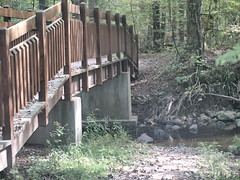
Hawn State Park Pictures - Sept 2010 Time gets away from you so easily, I'm afraid.  I am short on Old West research for my nano novel.  You may be in the same position as me.  So what can you do?  Schedule reading periods.  Read something before you start the day's writing.  Read something after you are done for the day that will help you with the next day's piece.  In my case, I have to decide what I need to know about Old West for each "key scene". 

For instance, the Beginning "Scene" or "Story Arc" is Walker's exile and entrance into a new world.  His first impression.  Originally, I envisioned this as a grassy open place with a dusty road, kinda nondescript.  If I want to hint at my Old West inspiration right away, I am going to have to do better than that.  That is where research comes in.  So nondescript is out, however whatever Walker sees cannot be super scary.  I am saving that for the Launch Scene/Arc, the first firm sign of this world's weirdness in the form of a supernatural and rather toothy horse.  So although this scene is short and my research vague, I know if I do some reading, I'll find that which I need.

The next key scene is the Launch.  It involves the actual meet of man-eating horse and man, so horse research is needed.  After all, the horse makes a living pretending to be that which it is not--a regular horse.  It has to act . . . horsey.

That is the first two bits of research I need to do.  How about you?  Research all done or do you conduct research on an as needed basis?

Friday, October 29, 2010

Influences

Recently, I was reading The Real Kate Chopin by Lorraine Nye Eliot--great book, especially for a yardsale find--and in it, Eliot wrote:

"For years Kate Chopin had been reading authors she admired in search of an authorial voice suited to her temperament.  She found it as she began to study and translate works of a French writer who would have as great an influence on her writing as Gustave Flaubert had on his."

It seems odd to seek in the voices of others your own voice, but I have to admit whether or not you seek, you can find it that way.  The biggest influence on a great deal of my fantasy writing is an author who taught me about how pace, action, and humor can co-exist with engaging characters, emotional connection, and angst.  He taught me this through his own works--books I could read in a day.  Books I couldn't put down.

I don't try to emulate this author.  I just try to learn what I can and apply it in my own way to my own works.

My greatest influence to this date is Jim Butcher and his Dresden Files series.  Chopin's was Guy de Maupassant.  Who is yours?

==========================

Links and Books of Interest in this Post:
(Through Amazon - Amazon Affiliate Sales)

Wednesday, October 27, 2010

Author, Lead Yourself

No one can tell you what to write.  No one ever should.  But you have to realize your choices comes with disadvantages.   Sun Tzu wrote in Art of War:

[In] the wise leader's plans, considerations of advantage and of disadvantage will be blended together.

As a writer, you are you own boss--your own leader.  You must know both the disadvantages and advantages of your choices to succeed as a writer. 

In my case, I choose to write what I like.  Which means, I choose a smaller audience that fantasy allows.  Of that genre, I choose a smaller subgenre.  Finally, I choose a smaller audience that non-traditional publishing allows.  But with self-epublishing, you can get your books into the hands of the readers faster.  It means I can write them to the length that fits the story--and my ever falling attention span.  It means that I can choose to write the books I want, when I want to write, and not be told I shouldn't write them because not enough quantity can be sold to make them viable.  It means I can experiment with them, as well.

There are advantages and disadvantages to every choice you make.  So I ask, what are you choices?  What advantages do they give you?  What disadvantages do they give you?  Do you write with both in mind?  Do you lead yourself?

==================

Links or Items of Interest:

Tuesday, October 26, 2010

Fantasy Q&A: World-Building and Fourth Wall

On a thread at the Fantasy Nano forum, someone brought up a question that every fantasy writer must address.  How do you explain the world-building or "rules" of your world in your novel to the reader without making it seem like you are explaining the world-building or "rules" to the reader.  Because in most fiction, you don't pierce or break the fourth wall--you, the author, don't talk directly to the readers.  It is a convention readers expect to be upheld.

So, how do you relay necessary information to your readers, so they can understand?

There are a lot of tricks out there.  Such as having a character who does not know the conventions of the society.  Or you can let the reader learn by immersion, like how Antonio Banderas's character in The 13th Warrior movie does to learn the language of his host people.  These and sundry other methods have advantages and disadvantages.

But whether or not you have a character introduced the rules of the world like us readers are, it doesn't change the fact that world-building affects more than a single situation.  It affects the whole novel.  This is true in the same way your character will change what plot options and events are possible, because he will only act and react in certain ways, different than another character will.  So, immerse your novel in world-building.  If you want to reveal how a certain magic works, do the obvious scene with it--and then go beyond it.  What indirect effects does this magic type have in the world.

For example, say your character needs to eat a certain plant to do perform a certain spell.  Then think that plant's implications.    

How is that plant integrated into his world--is it illegal?  Is it as common as aspirin?  Do you have to have a script to get it?  How expensive is it?  Can anyone use it?  Who sells it?  

What are the effects of the plant on the body--does it make the user high?  Does it give him indigestion?  Must he use more and more to get the same spell effect?  Is it addictive?  Does it react badly with other plant-based spells?  Does it eventually build up in the body, and the build up kills?
And so on.  Each answer gives you a possibility of showing something about your world-building in the novel.  In a line, in a paragraph, in a fragment of a scene; in a scene, in a chapter.  Small or large.  You can pick which tidbits are relevant to the current scene and show the rest later or not at all.  Some can be implied by the other answers.  You just have to play with it.  You just have to focus your scenes and chapters through an additional lens of world-building, by asking yourself constantly how world-building affects and is affected by this and this and this in your novel.

Basically, world-build in the details of your novel whenever possible.  Let your world-building be inseparable from your rest of your novel and its components of character and plot and so on.